



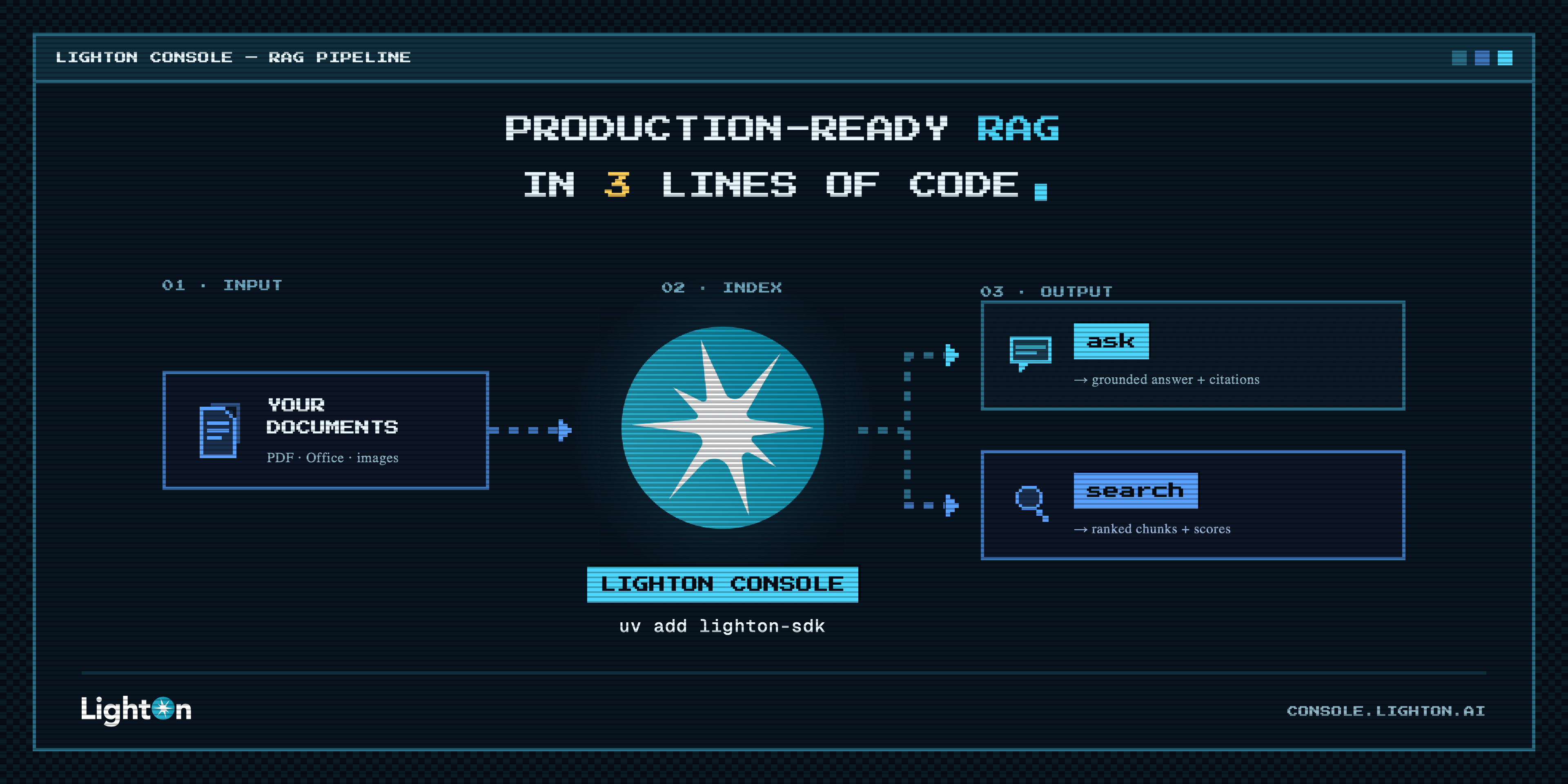
Seamlessly integrate state-of-the-art RAG directly into your software.
LightOn is a 🇪🇺 European AI lab building industrial-grade retrieval infrastructure: index your documents, then query them with grounded ask and search actions, and process documents on the fly with parse and extract for specific, standalone actions. This SDK wraps the LightOn API. Create an account and get an API key on console.lighton.ai 🚀
Note from the human maintainers:
This code-base is implemented with AI assistance to allow our team to keep up with the required development celerity, however be assured that all design-patterns, architectural decisions, code-reviews and QA cycles are fully human-backed to ensure that this SDK meet our standards of quality and that we maintainers keep full knowledge of its inner workings to better serve the developer community <3
- Quick start
- Ingestion
- Primary verbs
- Workspaces
- Files & ingestion
- Async jobs & polling
- Extract
- Tags
- Content types
- API keys
- Client configuration
- Agent Frameworks
Install:
uv add lighton-sdkSet your API key in your environment:
export LIGHTON_API_KEY="..."Get your first result:
from lighton import LightOn, Workspace

with LightOn() as client:  # reads LIGHTON_API_KEY from the environment
    # Create a workspace and ingest a folder of PDFs (glob), blocking until searchable
    ws = Workspace(name="Docs").create(client)
    ws.ingest_many(["docs/**/*.pdf"], wait=True)

    # Search: retrieve the most relevant passages, scoped to that workspace
    chunks = client.search("Q4 revenues", workspaces=[ws])
    for r in chunks.results:
        print(r.score, r.source.filename, r.content)

    # Single-turn RAG for simple use-cases, using an LLM registered on your account
    answer = client.ask(
        "What were Q4 revenues?", workspaces=[ws], model="mistral-large-latest"
    )
print(answer.answer)Get documents in first: ask/search only see files ingested into a workspace.
Upload one file with Workspace.ingest(), or many at once with ingest_many().
Uploading is the ingestion; a File carries a processing status you can poll.
from lighton import ExecMode, File, LightOn, Workspace

with LightOn() as client:
    ws = Workspace.get(client, 42)

    # One file, non-blocking (returns immediately, status "pending")
    f = ws.ingest(File(path="report.pdf"))
    ws.ingest(File(path="report.pdf"), wait=True)   # or block until embedded
ingest_many() takes paths, Files, and glob patterns (mixed). Every path is
validated before any upload; it returns a BatchIngest with succeeded / failed:
batch = ws.ingest_many(
    ["contracts/*.pdf", "reports/**/*.docx", File(path="extra.pdf")],
    wait=True,             # wait for each to finish embedding
    ignore_errors=True,    # collect failures instead of raising on the first
)
print(len(batch.succeeded), "ok,", len(batch.failed), "failed")
for fail in batch.failed:
    print(fail.source, "→", fail.error)
The client paces every request (uploads and status polls) to stay under a
per-minute cap and applies the 429 cooldown automatically. It defaults to 1000
requests/minute, the API's limit for most endpoints, so batches stay within bounds
out of the box. Override it if your account differs (or pass None to disable pacing):
from lighton import LightOnConfiguration

# override the default cap (or pass None to disable pacing)
with LightOn(config=LightOnConfiguration(max_requests_per_minute=2000)) as client:
    Workspace.get(client, 42).ingest_many(["docs/**/*.pdf"])
Run it in the background with mode=ExecMode.ASYNC and poll the job's progress:
import time

from lighton import BatchIngest, BatchProgress

with LightOn() as client:
    ws = Workspace.get(client, 42)
    job = ws.ingest_many(["docs/**/*.pdf"], wait=True, mode=ExecMode.ASYNC)

    while not job.done:
        p: BatchProgress = job.poll()
        print(f"{p.uploaded}/{p.total} uploaded, {p.ingested} embedded, {p.failed} failed")
        time.sleep(2)

    result: BatchIngest = job.wait()   # once finished
More on file management (list, fetch, tags, delete) and polling in Files & ingestion and Async jobs & polling.
Four actions live directly on the client. ask and search query your indexed
documents, scope them with workspaces=, tags=, or files= (objects or bare ids),
and narrow further with content_type=/attribute= (see
Content types).
parse and extract process a document on the fly, no indexing required,
extract can also target a file you already ingested, with file=. Full
reference at developers.lighton.ai. The per-verb
snippets below assume a client opened with with LightOn() as client:.
Retrieval-augmented generation: retrieves the most relevant chunks and has an LLM
answer your question grounded in them, returning the answer plus the sources it
used. Reach for it when you want a direct answer over a corpus. Choose the answering
model with model= (any LLM registered on your account).
resp = client.ask(
    "What were Q4 revenues?",
    workspaces=[42],
    max_results=5,
    model="mistral-large-latest",
)
print(resp.answer)
for r in resp.results:          # the chunks used as grounding
    print(r.source.filename, r.score)
Pass schema= to constrain the answer to structured output, same inputs as
extract (a pydantic model or a JSON-Schema dict, describing an object). The
answer comes back as JSON text in .answer, so parse it yourself:
from pydantic import BaseModel, Field


class Revenue(BaseModel):
    amount: float = Field(description="Revenue figure, in millions.")
    currency: str = Field(description="ISO 4217 code, e.g. 'EUR'.")
    quarter: str | None = Field(None, description="Fiscal quarter, or null.")


resp = client.ask("What were Q4 revenues?", workspaces=[42], schema=Revenue)
revenue = Revenue.model_validate_json(resp.answer)
print(revenue.amount, revenue.currency)
print(resp.results)             # sources still come back alongside
Pass stream=True for anything user-facing: you get Server-Sent Events instead of
one blocking call, so the answer appears as it generates rather than after it.
from lighton import DoneEvent, SourcesEvent, TokenEvent

for event in client.ask("What were Q4 revenues?", workspaces=[42], stream=True):
    if isinstance(event, SourcesEvent):
        print("grounded in", len(event.results), "chunks")   # arrives first
    elif isinstance(event, TokenEvent):
        print(event.text, end="", flush=True)                # the answer, as it lands
    elif isinstance(event, DoneEvent):
        print()
SourcesEvent.results holds exactly what non-streaming ask returns, so you can
show sources immediately and let the text fill in. Switching on event.type
("sources", "token", "done") works too, if that reads better than isinstance.
Streaming composes with schema=: the tokens spell out the JSON, so join them and
parse at the end.
text = "".join(
    e.text
    for e in client.ask("What were Q4 revenues?", workspaces=[42], schema=Revenue, stream=True)
    if isinstance(e, TokenEvent)
)
revenue = Revenue.model_validate_json(text)
Two things to know. It's a generator, so nothing is sent until you start
iterating, and a bad request surfaces on the first step rather than at the call;
iterate it fully or .close() it so the connection is released. And if generation
fails partway, you get a StreamError rather than a silently short answer, because
a truncated answer that looks finished is the worse failure.
Hybrid semantic + lexical retrieval that returns ranked chunks with scores, source metadata, and (optionally) page images, but no generated answer. Use it to feed context into your own pipeline/LLM, build custom ranking, or surface sources to users.
from lighton import RelevanceScoring, SearchMode

resp = client.search(
    "termination clause",
    tags=[7],
    mode=SearchMode.text,        # .text (hybrid) or .vision (page-image)
    include_image=True,          # attach a base64 page image per chunk
)
for r in resp.results:
    print(r.score, r.content)
Filter on the taxonomy with content_type= and attribute= (both apply to ask too):
resp = client.search(
    "termination clause",
    content_type=["legal:contract"],          # or a ContentType object
    attribute=["fiscal_year:2024|2025", "status:active"],
)
content_type paths are OR-matched and exact-or-subtree (legal also matches
legal:contract), with wildcards (legal:contract*, *nda*). attribute entries
are ANDed, | ORs within one entry; also name (has any value), name:>value,
name:prefix*, name:*text*.
relevance_scoring tunes the scoring step (applies to ask too):
.scoring_and_filtering(default): score, drop chunks below the quality threshold.scoring_only: score every candidate, return them all.none: skip scoring; lowest latency,r.scores.relevanceisNone
One-off conversion of a PDF, Office file, or image into structured per-page
Markdown, without storing it in your index. Ideal for feeding documents into another
tool. Pass a local path or a public url (exactly one).
doc = client.parse(path="report.pdf")
# doc = client.parse(url="https://example.com/report.pdf")
for page in doc.result.pages:
    print(page.index, page.markdown)
Large documents can time out synchronously, run them async and poll (see
Async jobs & polling): client.parse(path="big.pdf", mode=ExecMode.ASYNC).
Pull specific, typed fields out of a document for a custom pipeline: you describe the shape (a pydantic model or a raw JSON Schema) and get back data matching it, one object per page. See Extract below for the full schema guide.
resp = client.extract(schema=InvoiceModel, path="invoice.pdf")
# or, on a file already in your index: client.extract(schema=InvoiceModel, file=f)
print(resp.result.data)
Workspaces are the containers your documents live in, retrieval scopes to them. They're active-record objects: an instance manages its own lifecycle.
from lighton import LightOn, Workspace

with LightOn() as client:
    # Create
    ws = Workspace(name="Legal", description="Contracts & NDAs").create(client)

    # Edit, then persist
    ws.name = "Legal EU"
    ws.save()

    # Re-fetch from the API
    ws.refresh()

    # List (follows pagination) and retrieve by id
    for w in Workspace.list(client):
        print(w.id, w.name)

    ws = Workspace.get(client, ws.id)

    # Delete
ws.delete()Workspace.list() carries a few read-only fields worth knowing about, so you can
survey an account without a request per workspace:
for w in Workspace.list(client):
    print(w.name, w.files_count, w.user_role)     # your role: owner / editor / viewer

    if w.taxonomy:                                 # classification coverage
        print(f"  {w.taxonomy.classified_files_rate:.0%} classified")
        for root in w.taxonomy.root_content_types:
            print("  ", root.label, root.count)

    if w.sync:                                     # connected datasource, if any
        print("  synced from", w.sync.datasource_type, w.sync.last_status)
taxonomy is the cheapest way to see how much of a workspace is classified (see
Content types); it's None until something is. sync is None
for workspaces you upload to directly, and user_role is None when you hold no
role on the workspace.
One wrinkle: only list() returns taxonomy. The detail endpoint leaves the
field out, so get() and refresh() neither populate it nor clear an already-loaded
value; re-list when you want fresh coverage numbers.
Uploading a file into a workspace is the ingestion, there's no separate job to
track. The returned File carries a processing status; poll it with refresh(),
or wait() to block until it's embedded. Ingestion is non-blocking by default.
Once it's through, the document keeps both its original bytes and the text the
platform parsed, reachable with download() and pages().
from lighton import LightOn, Workspace, File, wait_all

with LightOn() as client:
    ws = Workspace.get(client, 42)

    # Upload, returns immediately, f.status == "pending"
    f = ws.ingest(File(path="report.pdf"))

    f.refresh()          # poll status whenever you like
    print(f.status)      # pending → parsing → embedding → embedded

    # Or block until ready (opt-in)
    ws.ingest(File(path="report.pdf"), wait=True)

    # Bulk upload, then wait on all concurrently (threads, the SDK is sync)
    files = [ws.ingest(File(path=p)) for p in ("a.pdf", "b.pdf", "c.pdf")]
    wait_all(files)

    # Manage existing files (active-record, like Workspace/ApiKey)
    for doc in File.list(client, workspace_id=42):
        print(doc.id, doc.filename, doc.status)

    doc = File.get(client, f.id)

    # Or fetch by name within a workspace — matches the title, so pass the name you
    # uploaded (the server uniquifies the stored filename). The extension is optional.
    # Returns every match (titles aren't unique), empty if there are none.
    # workspace takes a Workspace or an id.
    docs = File.get_by_name(client, "report.pdf", workspace=42)
    doc = docs[0]
    doc.title = "Q4 Report"
    doc.save()

    # Read back the text parsed at ingestion, no re-upload (see Getting the bytes back)
    for page in doc.pages():
        print(page.index, page.markdown)

    # Assign / remove tags, by Tag object, id, or name (see Tags below)
    doc.tag([7, "contracts"])
    doc.untag([12])

    # Or replace the whole set in one save (see External metadata below)
    doc.save(tags=["contracts", 7])

    doc.delete()

    # Deleting many? One request, not one per file.
    File.delete_many(client, File.list(client, workspace_id=42))
delete_many() takes File objects or bare ids (mixed), and is all-or-nothing:
if any id is unknown or isn't yours the API rejects the whole call and deletes
nothing, which surfaces as a NotFoundError. There is no partial-success report
because there is no partial success. An empty list is a local no-op.
Retrieval gives you passages; sometimes you need the document itself, to show it in a
UI or hand it to another tool. download() returns the stored bytes:
from pathlib import Path
from lighton import DownloadPurpose

Path("report.pdf").write_bytes(doc.download())                       # as uploaded
Path("render.pdf").write_bytes(doc.download(DownloadPurpose.rendered_pdf))
Already-ingested documents keep the text the platform parsed at ingestion, so you can read it back instead of re-uploading and re-parsing:
for page in doc.pages():
    print(page.index, page.markdown)
That's the same {index, markdown} shape parse
returns, the same Page model, so code can move between parsing a local file and
reading an ingested one without reshaping anything. It costs an extra request (the
text can be large), so it isn't part of refresh().
purpose= picks which stored version you get (original, rendered_pdf,
transcript); the server falls back to original when a document has no such
rendition, so it won't 404 on you for that.
Thumbnails (256x256 WebP) are generated asynchronously and independently of
ingestion, so an embedded file may still have none. Check before you fetch:
from lighton import ThumbnailStatus

doc.refresh()
if doc.thumbnail and doc.thumbnail.status is ThumbnailStatus.READY:
    Path("thumb.webp").write_bytes(doc.download_thumbnail())
Fetching one that isn't READY raises NotFoundError.
Documents ingested from a third-party system keep their origin with
ExternalMetadata, so a later sync can match a platform document back to the record
it came from. Set it on upload, or with save():
from lighton import ExternalMetadata, File

doc = ws.ingest(File(
    path="incident.pdf",
    external_metadata=ExternalMetadata(
        external_id="JIRA-123",
        doc_type="incident",
        additional_metadata={"url": "https://jira/INC-123", "version": 3},
    ),
))
print(doc.external_metadata.external_id)   # round-trips, including after refresh()
To change it, pass it to save(). Every update merges, all the way into
additional_metadata, so a partial edit leaves the other keys alone. There is no
replace or overwrite mode: merging is the only update the API offers.
doc.save(external_metadata=ExternalMetadata(doc_type="ticket"))
print(doc.external_metadata)   # external_id and additional_metadata are still there
Because everything merges, you remove a value by writing an empty one, and not everything can be removed:
| to remove | how |
|---|---|
doc_type |
ExternalMetadata(doc_type="") |
one key of additional_metadata |
ExternalMetadata(additional_metadata={"version": None}) |
external_id |
not possible, it can only be overwritten |
| the whole record | not possible |
doc.save(external_metadata=ExternalMetadata(doc_type=""))Treat
external_idas permanent. The API rejects it both blank (422 may not be blank) and null (422 may not be null), and there's no way to drop the record as a whole. Set it deliberately on upload; you can overwrite it later, never clear it.
save() absorbs the response, so doc.external_metadata always shows what the
server actually kept, not the partial value you sent.
It writes the title field, plus whatever you hand it explicitly. tags and
external_metadata are arguments rather than fields, because neither is a plain
set server-side and the keyword says which one you mean: tags replaces the whole
set, external_metadata merges. Omit either and that part is left alone:
doc.title = "Q4 Report"
doc.save()                          # writes only the title
doc.save(tags=["contracts", 7])     # replaces every tag (objects, ids, or names)
doc.save(tags=[])                   # removes them all
Use tag() / untag() to add or remove a few without replacing the rest.
filename is immutable server-side and never sent.
replace() swaps the content of an existing document and re-ingests it. The
document keeps its id, tags, and content-type classifications, so links and
stored references survive what used to need a delete plus a re-upload. The new file
can be of a different type.
doc.replace("report_v2.pdf", wait=True) # same id, new contentBecause titles and filenames aren't unique, replace() is addressed by id:
it's an instance method on a document you already resolved. Resolve it first with
File.get(client, id), or check what File.get_by_name() returned:
docs = File.get_by_name(client, "report.pdf", workspace=42)
if len(docs) != 1:
    raise SystemExit(f"{len(docs)} documents named report.pdf, pick one by id")
docs[0].replace("report_v2.pdf", wait=True)
Two things to expect. filename follows the new file while title is preserved, so
get_by_name() still finds the document under the name it was uploaded with. And the
response still describes the previous content, because the old version stays served
until re-ingestion actually starts; the queued work shows up as pending_reprocess:
doc.replace("report_v2.pdf")
print(doc.pending_reprocess, doc.status)   # "update" embedded  <- embedded is STALE
doc.wait()                                 # blocks while a reprocess is queued
print(doc.pending_reprocess, doc.status)   # None embedded      <- the new run
wait() treats a queued reprocess as not-terminal, so wait=True and a hand-written
doc.replace(...); doc.wait() are both safe. Reading status yourself right after a
replace is not: it reports the previous run until processing starts. wait=True accounts for that; if
you poll yourself, don't trust the first status you read back.
Once a file reaches embedded, it's retrievable by ask/search. You can also
run extract straight on it, client.extract(schema=Invoice, file=doc), instead
of uploading the document a second time (see Extract).
Two things in the SDK are asynchronous and polled: ingestion (a File's
status, via refresh() / wait() shown above) and parse / extract run in
async mode, which return a job handle you poll. Same idea in both, kick off
the work, poll until it reaches a terminal state.
parse and extract take mode= (an ExecMode, default ExecMode.SYNC).
Pass ExecMode.ASYNC to queue the job, the call returns a ParseJob /
ExtractJob handle instead of blocking. Call job.poll() to refresh it in place;
job.succeeded is the one success state and job.done means terminal (finished
either way). Handy for large documents that would otherwise time out.
import time

# queue the job, returns right away, job.status == "pending"
job = client.extract(schema=Letter, path="big-scan.pdf", mode=ExecMode.ASYNC)

while not job.poll().succeeded:
    if job.done:                                # terminal but not completed → failure
        raise RuntimeError(f"extract job {job.id} ended as {job.status!r}")
    if job.progress:                            # optional live progress
        print(f"{job.progress.percentage}% ({job.progress.pages_processed} pages)")
    time.sleep(2)

for row in job.result.data:
    print(row)
poll() mutates the job and returns it, so while not job.poll().succeeded:
reads naturally; raising once job.done (terminal but not successful) means a
stuck or failed job surfaces instead of looping forever.
If you don't need live progress, don't write the loop: pass wait=True to block
until the job is terminal (same wait= / timeout= pair as ingest), or call
job.wait() yourself. Both return the finished job, raise TimeoutError past
timeout (default 300s), and raise LightOnError if the job ends in failure, so
the result is there when the call returns.
# async endpoint (no sync timeout to hit), but blocking, no polling code
job = client.extract(schema=Letter, path="big-scan.pdf", mode=ExecMode.ASYNC, wait=True)
for row in job.result.data:
    print(row)

# equivalent, and how to tune the poll interval
job = client.parse(path="big.pdf", mode=ExecMode.ASYNC).wait(timeout=1800, poll=5)
wait=True only makes sense with ExecMode.ASYNC (sync already blocks); passing
it without is a ValueError.
parse is the same shape, on failure a ParseJob carries an error block you
can raise with directly:
import time

job = client.parse(path="big.pdf", mode=ExecMode.ASYNC)

while not job.poll().succeeded:
    if job.error is not None:                   # terminal failure
        raise RuntimeError(f"parse job {job.id} failed: {job.error.message}")
    time.sleep(2)

for page in job.result.pages:
print(page.index, page.markdown)extract(schema, *, path | url | file) pulls structured data from a document.
Pass exactly one source:
path=: a local file, uploaded multiparturl=: a publicly accessible URL the server fetchesfile=: a file already ingested into your index (aFileor a bare id), no re-upload, the cheap option when the document is already there
The schema drives guided generation and can be a pydantic model or a raw
JSON-Schema dict, use whichever you have.
A pydantic model is the easy path: nested models, list[...], and X | None
fields all convert to a valid vLLM response_format schema for you.
Give every field a meaningful Field(description=...), the descriptions are
carried into the schema and steer the model, so they materially improve
extraction quality. Treat them as instructions, not documentation.
from lighton import LightOn
from pydantic import BaseModel, Field


class Person(BaseModel):
    last_name: str = Field(description="Family name, as written in the document.")
    first_name: str | None = Field(
        None, description="Given name; null if not stated."
    )
    role: str | None = Field(
        None, description="Title or role if given, e.g. 'sender', 'recipient'."
    )


class Letter(BaseModel):
    people: list[Person] = Field(
        description="Every person or entity named in the letter."
    )
    subject: str | None = Field(
        None, description="The letter's stated subject line, or null if absent."
    )


with LightOn() as client:
    resp = client.extract(schema=Letter, path="letter.pdf")
    # or from a public URL: client.extract(schema=Letter, url="https://example.com/letter.pdf")
    for row in resp.result.data:          # one object per page
        print(row)
Or pass the schema dict directly, it's validated against the JSON-Schema
meta-schema (raises jsonschema.SchemaError if malformed), then normalized the
same way a model is: the endpoint rejects $ref, so $defs/$ref are inlined
whether the schema came from a model class or from your own
Model.model_json_schema() call:
with LightOn() as client:
    resp = client.extract(
        url="https://example.com/invoice.pdf",
        schema={
            "$schema": "https://json-schema.org/draft/2020-12/schema",
            "type": "object",
            "properties": {
                "total": {"type": "number"},
                "currency": {"type": ["string", "null"]},
            },
            "required": ["total"],
        },
    )
    print(resp.result.data)
Need the converted schema without calling the API (to inspect or cache it)?
from lighton.utils import convert_pydantic_to_response_format_json

schema = convert_pydantic_to_response_format_json(Letter)
Tags scope ask/search to documents carrying them. They're flat labels with no
values, which makes them the right tool for cross-cutting marks (confidential,
q4-review) that cut across document kinds; for what a document is, and for
filtering on typed values, see Content types.
Active-record style, but the API is list/create/delete only, there's no
fetch-by-id, so get() / refresh() raise NotImplementedError.
Manage tags:
from lighton import LightOn, Tag

with LightOn() as client:
    # Create
    contracts = Tag(name="contracts", description="Signed contracts").create(client)

    # List (follows pagination)
    for t in Tag.list(client):
        print(t.id, t.name, t.document_count)

    # Delete
    contracts.delete()
Assign tags to a file with tag() / untag(). Both accept Tag objects, bare
ids, or tag names (mix freely); names are resolved via Tag.list() under the
hood and a name that doesn't exist raises ValueError:
from lighton import File

doc = File.get_by_name(client, "nda-2026.pdf", workspace=42)[0]

doc.tag([contracts])                 # Tag object
doc.tag([12, 13])                    # bare ids
doc.tag(["contracts", "urgent"])     # names, resolved & existence-checked
doc.tag([contracts, 12, "urgent"])   # mixed

doc.untag(["urgent"])                # remove by name
Scope a query to one or more tags (OR-matched, a doc matches if it has any).
Like File.tag(), tags= takes Tag objects, ids, or names (names resolved
via Tag.list(), unknown ones raise):
answer = client.ask("What are the termination terms?", tags=[contracts])
hits = client.search("indemnification", tags=["contracts", 12])Semantic search is good at what does this say and bad at which documents count. Ask for termination clauses across 50,000 documents and you get the most similar-looking passages in the whole corpus, supplier invoices and last year's HR handbook included.
Content types fix that by giving documents a category and typed fields, so you can narrow the corpus before the search runs, and answer questions that aren't semantic at all ("every contract signed in France in 2024"). Three words, one SDK class each:
- Content type (
ContentType): a node in your company-wide taxonomy tree, such aslegal:contract:nda. It says what kind of document this is. - Attribute (
Attribute): a typed field on a content type, such asjurisdiction(select) orsigned_on(date). It says what you can record. - Facet (
Facet): one content type assigned to one file, together with that file's attribute values. It says what this document actually is.
The payoff lands in retrieval, where content_type= and attribute= filter both
ask and search:
# 1. describe the kind of document, once, company-wide
nda = ContentType.define(client, "nda", "NDA", parent="legal:contract")
ContentType.define_attribute(
    client, nda, "jurisdiction", AttributeType.select, choices=["FR", "US", "UK"]
)

# 2. classify a document and record its values
doc.classify(nda)
doc.set_attribute(nda, "jurisdiction", "FR")

# 3. retrieve against the narrowed corpus
client.search(
    "termination clause",
    content_type=["legal:contract:nda"],
    attribute=["jurisdiction:FR"],
)
Matching is exact-or-subtree, so classifying precisely still answers broad
questions: a document filed under legal:contract:nda also comes back for
content_type=["legal"]. That is the difference from tags, which are flat
labels with no values. Reach for tags for cross-cutting marks like confidential,
and content types for what a document is.
ContentType.list() returns the tree (each node has children, and attributes
when include_attributes=True):
from lighton import ContentType

for ct in ContentType.list(client, include_attributes=True):
    print(ct.path, ct.label)
    for attr in ct.attributes:
print(" ", attr.name, attr.type, attr.choices)Assign a content type and record its attribute values. classify, unclassify,
set_attribute, and clear_attribute all take a ContentType object or a plain
path string, so you can pass whichever you have to hand:
from lighton import File

doc = File.get_by_name(client, "nda-2026.pdf", workspace=42)[0]

doc.classify("legal:contract:nda")
doc.set_attribute("legal:contract:nda", "jurisdiction", "FR")
doc.set_attribute("legal:contract:nda", "signed_on", "2026-07-01")  # date → "YYYY-MM-DD"

# Inspect what's assigned (a Facet per content type, with attribute values)
for facet in doc.facets():
    print(facet.path, {a.name: a.value for a in facet.attributes})

doc.clear_attribute("legal:contract:nda", "jurisdiction")
doc.unclassify("legal:contract:nda")Starting from nothing? Adopt a starter tree from the catalog:
for tpl in ContentType.templates(client):
    print(tpl.path, tpl.label)          # legal, healthcare, finance, tech, ...

ContentType.adopt(client, ["legal", "finance"])
Or define your own. Nodes and attributes are both idempotent: defining an
existing one updates it, so define() is also how you rename:
from lighton import AttributeType

compliance = ContentType.define(client, "compliance", "Compliance")
audit = ContentType.define(client, "audit-report", "Audit Report", parent=compliance)

ContentType.define_attribute(client, audit, "fiscal_year", AttributeType.number)
ContentType.define_attribute(
    client, audit, "jurisdiction", AttributeType.select, choices=["FR", "US", "UK"]
)
code is lowercase alphanumeric with hyphens (audit-report), attribute name is
snake_case, and choices is required for select and multi-select (passing
neither raises before the request goes out).
Removing cascades, so undefining a node takes its whole subtree with it:
ContentType.undefine_attribute(client, audit, "fiscal_year")
ContentType.undefine(client, "compliance")   # also removes compliance:audit-report
Building a tree is several calls, so batch() sends them in one request. Each entry
is the body a single method would send, and you get one result per action, in order:
results = ContentType.batch(client, [
    {"action": "adopt", "content_types": ["legal"]},
    {"action": "define_attribute", "content_type_path": "legal",
     "name": "jurisdiction", "attribute_type": "select", "choices": ["FR", "US"]},
])
print([r["status"] for r in results]) # [201, 201]Same active-record style. The plaintext secret is available only right after create().
from lighton import LightOn, ApiKey, ApiKeyScope, Role

with LightOn() as client:
    key = ApiKey(
        name="ci-pipeline",
        scopes=[ApiKeyScope(workspace_id=42, role=Role.viewer)],  # omit for an unscoped key
    ).create(client)

    print(key.key.get_secret_value())  # plaintext secret (SecretStr), shown once, store it now

    # Manage existing keys
    for k in ApiKey.list(client):
        print(k.id, k.name, k.prefix)

    key = ApiKey.get(client, key.id)
    key.name = "ci-pipeline-v2"
    key.save()
key.delete()LightOn() with no arguments reads LIGHTON_API_KEY from the environment and talks to
https://api.lighton.ai. To point it somewhere else — a self-hosted deployment, a
staging environment, a local instance — pass a base_url:
from lighton import LightOn, LightOnConfiguration

with LightOn(
    api_key="sk-...",  # or omit and let it read LIGHTON_API_KEY
    config=LightOnConfiguration(base_url="https://lighton.internal.acme.com"),
) as client:
    print(client.search("onboarding policy").results)
base_url is the host only: the SDK appends the /api/v3/... paths itself, and a
trailing slash is stripped, so https://host/ and https://host behave the same.
Everything on LightOnConfiguration is optional and independent, override only what
you need:
| field | default | what it controls |
|---|---|---|
base_url |
https://api.lighton.ai |
API root; point at another deployment |
timeout |
5 s connect, 120 s read | httpx.Timeout; raise the read timeout for slow parses |
retries |
3 |
connection-level retries with backoff (httpx transport), not HTTP errors |
max_requests_per_minute |
1000 |
paces every request under the API cap; None disables pacing |
rate_limit_retries |
3 |
retries on HTTP 429, waiting Retry-After when present; 0 disables |
transport |
None |
a custom httpx.BaseTransport, for a proxy, or MockTransport in tests |
The API key stays a direct LightOn() argument rather than a config field, so a
config object can be shared or logged without carrying a secret.
A local instance over plain HTTP, with a longer read timeout and no pacing:
import httpx

config = LightOnConfiguration(
    base_url="http://localhost:8000",
    timeout=httpx.Timeout(600.0, connect=5.0),
    max_requests_per_minute=None,
)
with LightOn(config=config) as client:
...LightOn drops into any agent framework as a retrieval tool: wrap a client.search()
call that returns text the LLM can read, and hand it to your agent. (Swap search for
ask if you'd rather the tool return a grounded answer than raw chunks.)
The snippets assume a client (see Quick start), in a long-running
agent, open it once for the process lifetime. They share this helper, which searches a workspace and formats
the hits into a string:
def lighton_search(query: str) -> str:
    """Search the company's document corpus for passages relevant to the query."""
    resp = client.search(query, workspaces=[42], max_results=5)
return "\n\n".join(f"[{r.source.filename}] {r.content}" for r in resp.results)# pip install langchain-core
from langchain_core.tools import tool
lighton_tool = tool(lighton_search) # name + description come from the function
# bind it: llm.bind_tools([lighton_tool]), or pass to create_react_agent(...)Reuses the LangChain lighton_tool above, pass it to a prebuilt ReAct agent:
# pip install langgraph
from langgraph.prebuilt import create_react_agent

agent = create_react_agent(model="openai:gpt-5", tools=[lighton_tool])
result = agent.invoke({"messages": [{"role": "user", "content": "What were Q4 revenues?"}]})# pip install llama-index-core
from llama_index.core.tools import FunctionTool
lighton_tool = FunctionTool.from_defaults(fn=lighton_search)
# agent = ReActAgent.from_tools([lighton_tool], llm=...)# pip install openai-agents
from agents import Agent, function_tool
agent = Agent(name="Search", tools=[function_tool(lighton_search)])# pip install crewai
from crewai.tools import tool
lighton_tool = tool("lighton_search")(lighton_search)
# pass tools=[lighton_tool] to your crewai Agent